
The Power of a Library- WIU x Book Aid
Written by Windle International Uganda staff
What was once a quiet and underused room at Highland Primary School has become a vibrant hub of learning, curiosity, and opportunity.
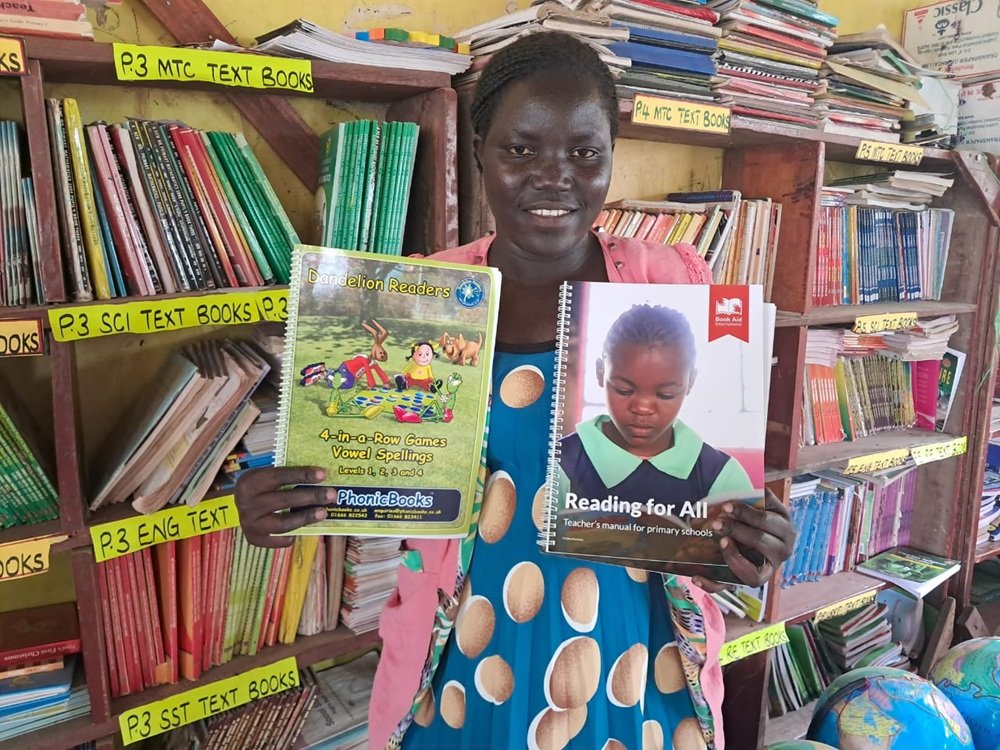
At the heart of this transformation is Candiru Hellen, a teacher and school librarian whose journey reflects the impact of the Reading for All Project, implemented by Windle International Uganda with support from Book Aid International.
Just a few months ago, Hellen admits she did not see the value of the school library. Time spent there, she believed, was unproductive for both her and her pupils. The space itself reflected this perception books were disorganized, systems were absent, and the library lacked the structure needed to support meaningful learning.
Everything changed when Hellen participated in a comprehensive library management training delivered across 34 schools under the Reading for All Project.
Through the training, she gained practical skills that immediately reshaped how the library functions. She learned how to catalogue books using accession registers, track circulation through borrowing and lending records, and monitor usage with activity logs. She also discovered how to organize and maintain a welcoming, learner-friendly reading space.
Today, the difference is clear.
Books are systematically arranged and easy to access. Borrowing is well managed. The library is no longer chaotic it is structured, purposeful, and actively used.
But the transformation goes beyond organization.
Hellen has also changed how she engages with her learners. She now actively supports pupils in selecting appropriate reading materials, guiding them through texts, and building both confidence and comprehension.
Among the resources she values most are the Four in a Row Games Vowel Spelling Books (Levels 1–4). These materials help pupils develop pronunciation and understand vowel sounds, making it easier for them to form English syllables and improve their reading fluency.
She also highlights the Reading for All Teacher’s Manual for Primary Schools as an essential guide. Beyond library management, it provides practical strategies for supporting children’s reading development—something Hellen says has significantly improved her teaching approach.
One of the most visible outcomes of this renewed energy is the establishment of a school reading club.
What began as a simple initiative has grown into an active and engaging platform where learners come together to read, share stories, and participate in reading competitions. The club has sparked enthusiasm among pupils, turning reading into an activity they genuinely look forward to.
The impact is beginning to extend beyond the school as well.
Despite limited resources, parents have started borrowing books—an encouraging sign that a culture of reading is taking root within the wider community.
However, this growing interest also highlights an ongoing need.
“We need more books,” Hellen says. “The ones we have are not enough for both learners and parents who are now eager to read.”
Even so, her optimism remains strong. She is confident that the changes brought about by the Reading for All Project will lead to improved academic performance.
Learners are already showing progress in reading, vocabulary, interpretation, and comprehension—skills that are essential for success across all subjects.
Hellen’s story is a powerful reminder that with the right training, resources, and support, a school library can become far more than a room filled with books—it can be a catalyst for lasting educational transformation.